Entry 29Pattern
Whitewall
A block of white up the lower side, between the legs.
W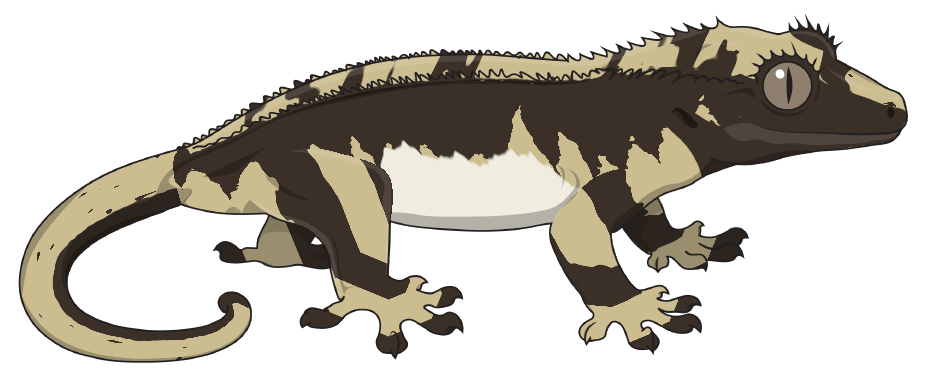
What it looks like
Whitewall is a thick band of solid white or cream along the lower sides, running from the front legs to the back legs and reaching fairly high up the flank; Foundation Genetics notes it often comes with raised scales. How high it climbs and how straight its top edge runs vary: harlequin markings can cut into it, some geckos have jagged or aberrant walls, and on geckos with porthole markings AC Reptiles gets big white bubbles instead of a flat wall.
AC Reptiles finds Tangerine can tint the white a pinkish peach, that on yellow or orange Phantoms the wall is sometimes heavily muted, and that the gene seems to widen the pale fringe on the hind legs too. In his experience a strong Whitewall can look like a hatchling Lilly White, but it doesn't gain white with age the way a Lilly does.
The series
Same animal, same seed. Only this gene changes. Open any one in the builder.
With another gene
The same gecko before and after.
Whitewall next to Lilly White
The white of a Whitewall stops on the lower side. A Lilly White takes the whole animal, and adds its highlighter accent along the belly.
Notes
How it is inheritedAC Reptiles calls the gene behind this look Whiteout and describes it as incomplete dominant. One copy gives white side markings that can be subtle enough to go unnoticed; two copies give the full Whitewall, and he thinks a separate gene for striped side markings is what makes the walls flat and continuous. In his account, two geckos with two copies of Whiteout give only two-copy babies, and a two-copy Whiteout paired with a non-Whiteout gives all one-copy babies. That explains walls appearing out of nowhere: Foundation Genetics recounts that Caponetto sold many subtle one-copy Whiteouts for years without knowing they could make Whitewalls.
Where breeders differA wall on its own doesn't tell you whether a gecko has one copy or two: harlequin can lower a two-copy wall, and not every two-copy Whiteout has flat, continuous walls. AC Reptiles notes some keepers might argue that a wall whose edge doesn't cut straight across isn't a true Whitewall.
Where it came fromAnthony Caponetto of AC Reptiles named the gene Whiteout, because its markings looked painted on with correction fluid, and called the two-copy form Extreme Whiteout until he heard the name Whitewall. Foundation Genetics credits Matt Parks of Pangea and Caponetto with introducing the look, and says Caponetto had been producing it since about 2004 or 2005; walls first seemed to pop up out of nowhere in Harry × original Soft Scale pairings. Who first used the name Whitewall is still unsettled.
In Gecktopia
Whitewall is its own gene in the game, drawing solid white up the lower side with one copy or two. One copy is named Whiteout, and two copies are named Whitewall.
- Passed on in the game as incomplete dominant.
Sources
Anthony Caponetto / AC Reptiles, date not established
Anthony and Jessica Vasquez, Tom Favazza and breeder collaborators, date not established
Entry 29 of 33. Every gecko on this page was drawn from its own genes just now, by the renderer that draws them in the game.