Entry 12Colour modifier
Tangerine
Warm orange to pink pigment, tied to named breeding lines.
TANG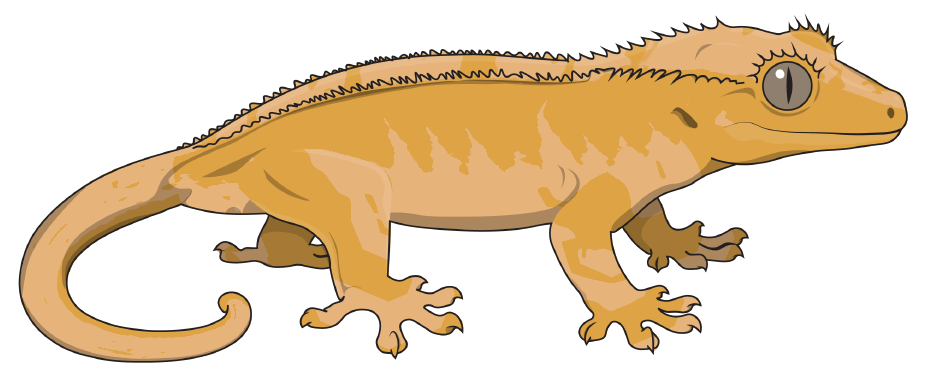
What it looks like
Tangerine is a warm orange to pink pigment tied to named breeding lines. AC Reptiles describes a pinkish orange that can tint the whole gecko or parts of it: the dorsal, the side markings, even the base colour if it is light enough.
Strength varies a lot: Gecko Nerd describes strong ones as bright orange, others closer to yellow, with pink or coral tones in combinations. AC Reptiles finds white markings can turn pink. On weaker geckos the colour shows well in hatchlings and fades as they mature, while AC Reptiles' recent generations often keep it into adulthood. Similar orange can come from other routes, so an orange gecko isn't automatically a Tangerine.
The series
Same animal, same seed. Only this gene changes. Open any one in the builder.
With another gene
The same gecko before and after.
Phantom Tangerine goes tangerine all over
Tangerine only colours pattern, so a Tangerine that turns orange from head to tail tells you something about Phantom: the film Phantom lays over the gecko is pattern itself. Tangerine paints that film, and the whole animal goes with it.
The base stays where it was
On a Black base the pattern warms right up while the body behind it stays dark. That contrast is the easiest way to tell Tangerine from a gene that shifts the whole animal.
Named combinations
Morphs that need this gene and at least one other.
Bubblegum Pinktakes some work
A bubblegum pink pattern colour: Tangerine shifts white pattern toward pink, and Hypo lightens it further. AC Reptiles also uses Bubblegum for its own Tangerine line, and the pink can appear without all three.
NeedsHypoTangerineWhite Pattern
Citruseasy to breed
Bright citrus-orange to yellow-orange, more saturated than Tangerine alone, with Yellow Base boosting the orange. Citrus is also AC Reptiles' line name, and a citrus colour does not require Tangerine.
NeedsYellow BaseTangerine
Strawberry Blondetakes some work
Warm strawberry to coral-blonde: Red Base gives the warm red undertone and Tangerine adds orange, softer and warmer than an orange Tangerine. Breeders set their own definitions for the name.
NeedsRed BaseTangerine
Tangerine Lillytakes some work
Warm orange or peach on a Lilly White: Tangerine shifts the usual Lilly cream toward orange, and Foundation Genetics reports some turning deep tangerine or highlighter yellow with age.
NeedsTangerineLilly White
With other genes
White Patterntints it
Tangerine tints white pattern pink, the bubblegum look.
Notes
How it is inheritedAC Reptiles, which named the crested gecko colour Tangerine, says it “does not seem to work in an allelic (incomplete dominant or recessive) manner, but is rather a selectively bred trait”, just like Tangerine in leopard geckos. A selectively bred trait is line bred: Tangerines are bred together over generations, outcrossing along the way, to build how intense the colour is. Early Tangerines showed the colour as hatchlings and faded as they matured; breeding two together gave some far more intense babies, and after generations of this, AC Reptiles’ recent Tangerines often keep the colour into adulthood. Its Tangerine page shows an early-generation Tangerine beside a current Bubblegum line gecko of about the same age: the newer gecko’s white markings are pink, while the older one has only a faint tinge (AC Reptiles, Tangerine). Caponetto adds that his modern, intensely pigmented Tangerines bred to non-Tangerines give more extreme babies, more consistently, than his most intense Tangerines bred together 10 to 12 years ago, which an incomplete dominant gene would not do (Anthony Caponetto, AC Reptiles, correspondence with Gecktopia, September 2026).
Where breeders differGecko Nerd and Foundation Genetics describe Tangerine as incomplete dominant instead, with Super or Hyper Tangerine as the stronger form when both parents pass it on (Gecko Nerd, Let's Talk Tangerine & Phantom, shared on Facebook; Foundation Genetics Part 2.1). That view is not yet shown by pairing results: none of these accounts gives pairing counts that would decide between the two. The accounts also differ on where the colour goes: Gecko Nerd says Tangerine colours the pattern only, while AC Reptiles describes it tinting the base colour too.
Where it came fromAnthony Caponetto of AC Reptiles found the founding female in 2004, in a group of 20 hatchlings bought sight unseen, and by 2006 knew the colour passed on. He named it Tangerine because the colour matches Tangerine in leopard geckos, a selectively bred trait there (Anthony Caponetto, AC Reptiles, correspondence with Gecktopia, September 2026). Tangerine pigment in leopard geckos was first identified, named and developed by David Nieves, a fellow Kansas City breeder, in the early 1990s (AC Reptiles, Tangerine). Caponetto spent about a decade breeding it into many lines and base colours; his most intense current generation is his Bubblegum line. Gecko Nerd later added breeding observations and its incomplete-dominant view.
In Gecktopia
The game uses the incomplete-dominant model: a gecko carries zero, one or two copies, and two copies are drawn as Super Tangerine. How strongly it shows varies from gecko to gecko. The game commits to this model while the reference records the dispute.
- Passed on in the game as incomplete dominant.
Sources
Anthony Caponetto / AC Reptiles, date not established
Correspondence with Gecktopia
Anthony Caponetto / AC Reptiles, September 2026
Private correspondence, cited with permission; not published online.
Let’s Talk Tangerine & Phantom
Gecko Nerd, 21 July 2026
Gecko Nerd Tangerine and Phantom slides
Gecko Nerd, date not established
Supplied to Gecktopia as slides; not published online.
Anthony and Jessica Vasquez, Tom Favazza and breeder collaborators, date not established
Anthony Caponetto / AC Reptiles, date not established
Reviewed through search results; the page itself could not be read in full.
Foundation Genetics contributors, date not established
Entry 12 of 33. Every gecko on this page was drawn from its own genes just now, by the renderer that draws them in the game.