Entry 28Pattern
Tiger
Dark bands down the side, with the pattern pushed into the gaps.
TIG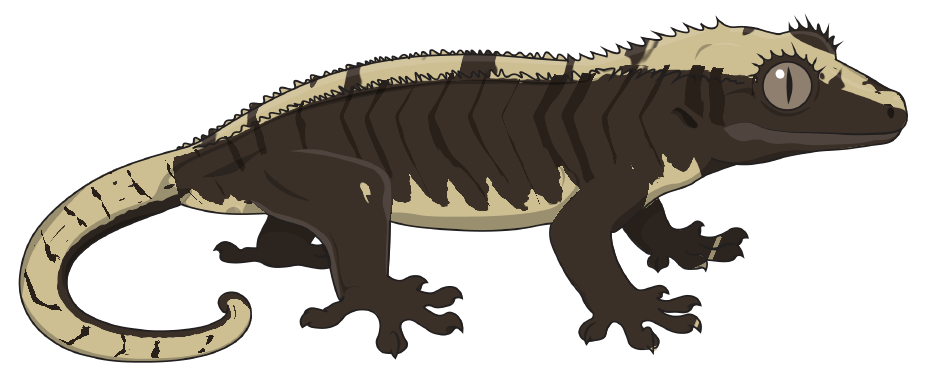
What it looks like
Tiger is the dark banding that runs across the body and back, from thin, nearly straight bars to broad, broken bands with jagged edges. The lighter pattern colour gets pushed into the gaps between the bands, which is how flame and harlequin markings end up broken into vertical sections.
Foundation Genetics describes the range: strong tigering gives long, heavy bands, weak tigering leaves smoother colour with a little freckling, and on heavily patterned geckos it can shatter the pattern into flecks. It sees brindle, chevron backs and reverse pinning as tigering meeting other pattern traits. Band width, spacing and contrast vary a lot, even between siblings.
The series
Same animal, same seed. Only this gene changes. Open any one in the builder.
With another gene
The same gecko before and after.
Brindle is broken tiger
On a Brindlequin (Yellow, White Pattern, Harlequin, Pinstripe and a visible Tiger) the bands break into pieces.
Named combinations
Morphs that need this gene and at least one other.
Brindlequinadvanced
A Harlequin broken up by strong, brindled tiger banding into yellow, white and dark bands. Foundation Genetics defines it as a white-pattern Harlequin on a yellow base with strong tigering and lighter pinning, and calls it a combination rather than a single gene.
With other genes
Pinstripeshape each other
The balance between Tiger and Pinstripe shapes the pattern: pinning pulls it lengthways and tigering across the body, giving looks such as brindle and reverse pin.
Notes
How it is inheritedBreeders select for tigering like other looks: Foundation Genetics says it can be bred towards neat, even bands or towards more broken, aberrant ones. It also treats tigering as something every crested gecko has, varying in strength rather than being present or absent, and says it hasn't managed to breed it out so far. No one has shown it passes on as a single gene you can count copies of, so there are no set odds for how much tigering a pairing will give.
Where breeders differOlder guides treated Tiger as a fixed dominant gene in every gecko and said the balance between Tiger and Pinstripe decides the look. Foundation Genetics pictures pinstripe pulling pattern lengthways and tiger pulling it across the body; banding and pinning clearly change each other's look, but no fixed rule for it has been shown.
Where it came fromNo single founder is on record for this name. It is shared hobby vocabulary. Foundation Genetics notes tigering was already seen in some of the first wild-collected crested geckos, and quotes early hobby writing that many bright 'fire' geckos descend from wild-collected 'patternless' and 'tiger' adults.
In Gecktopia
Every gecko in the game carries a banding layer, and geckos called Tiger show it strongly. That is how the game draws banding, not a claim that every real crested gecko carries a Tiger gene.
- Every gecko carries it in the game, so it never changes a pairing.
Sources
Keeper’s Choice crested gecko descriptions
Pangea Reptile, date not established
Anthony and Jessica Vasquez, Tom Favazza and breeder collaborators, date not established
Anthony Vasquez / Foundation Genetics, 13 June 2023
Entry 28 of 33. Every gecko on this page was drawn from its own genes just now, by the renderer that draws them in the game.