Entry 15Pattern
Empty Back
Thins or clears the pattern down the middle of the back.
EB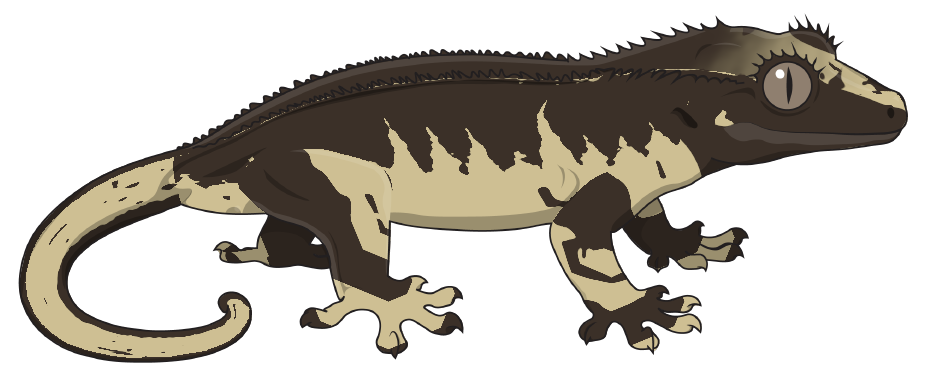
What it looks like
Empty Back thins out the pattern inside the dorsal borders, so more of the base colour shows down the middle of the back while the pinstripe edges stay. In the strongest geckos the back is almost empty of pattern colour, leaving little more than the pinning and the base colour, and Foundation Genetics notes the pinstripe scales on these geckos are often noticeably raised.
On yellow-based and Tangerine geckos the colour tends to be changed rather than cleared, and Foundation Genetics finds the look most striking on a dark black base. A one-copy gecko can be hard to spot: AC Reptiles finds a heavy cream dorsal, a Lilly White dorsal or Phantom can hide it, while the super form is far more extreme and much harder to mask. A fairly plain back on its own doesn't make a gecko an Empty Back.
The series
Same animal, same seed. Only this gene changes. Open any one in the builder.
With other genes
Harlequinpull against each other
Empty Back clears the back pattern that Harlequin concentrates there.
Related looks
Combinations, two-copy forms and named variations built on this one.
Super Empty BackDosage form
The super form of Empty Back, which AC Reptiles reports when a gecko carries two copies. Most of the back shows base colour, and it is much harder for other pattern to hide than the one-copy form. A very clear back can have other causes, so breeding history is the surest guide.
Notes
How it is inheritedEmpty Back masks the pattern on the back. One copy, plain Empty Back, thins it; two copies, the Super Empty Back, clear most of it, and how much is masked varies with how strongly it shows. AC Reptiles describes it as incomplete dominant, and Foundation Genetics describes it the same way. Because one-copy geckos can be hidden by a creamy dorsal, Lilly White or Phantom, AC Reptiles reports producing dozens of supers from parents he didn't know were carrying it, so a gecko's breeding history tells you more than its back does. If you're buying from another line, he suggests checking whether it is known to produce a Super Empty Back, as a sign it's the same gene.
Where breeders differAC Reptiles mentions that breeders once talked privately about calling Empty Back recessive, because some one-copy geckos are so hard to pick out. Older guides also said Empty Back overrides Harlequin; clearing the back can change how a heavily patterned gecko looks, but no one has shown it always wins out.
Where it came fromAnthony Caponetto of AC Reptiles recognised Empty Back in his collection around 2017 and has developed the project since. He first noticed it on Harry-line geckos whose pinning ran up to the head, and thinks he had been producing one-copy geckos in small numbers for years before that. He believes they all trace back to Repashy stock, mostly by way of his own collection, and are the same gene; an earlier spread through older stock is possible but hasn't been shown.
In Gecktopia
Empty Back is incomplete dominant in the game: one copy reduces the pattern on the dorsal and two copies, Super Empty Back, clear it.
- Passed on in the game as incomplete dominant.
Sources
Anthony Caponetto / AC Reptiles, date not established
Anthony and Jessica Vasquez, Tom Favazza and breeder collaborators, date not established
Entry 15 of 33. Every gecko on this page was drawn from its own genes just now, by the renderer that draws them in the game.