Entry 17Pattern
Harlequin
Pattern spills onto the sides and legs.
HQ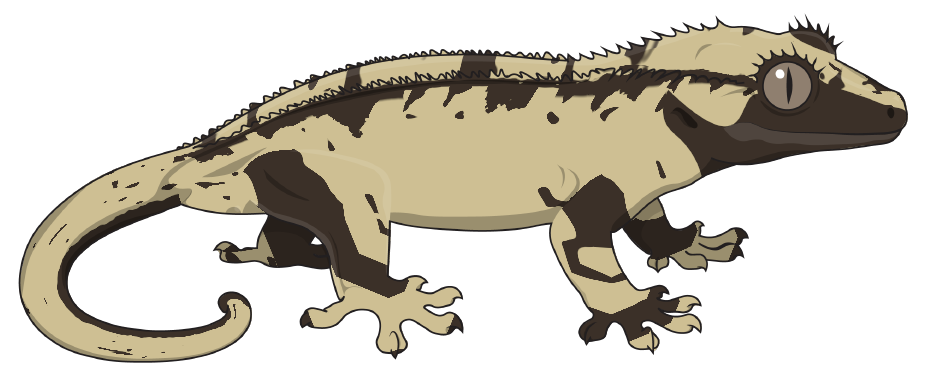
What it looks like
A Harlequin's pattern doesn't stay on the back: it spills down onto the sides and legs. FoxReptiles' guide describes Harlequins as Flames with more pattern, carried along the lower sides and limbs, and Foundation Genetics describes the markings as overlapping ovals and blobs around the legs and flanks, in anything from cream or paper white to deep reddish orange.
Coverage varies from gecko to gecko, and the most heavily patterned animals are often called Extreme or Super Harlequin; in FoxReptiles' guide an Extreme covers roughly 80% of the upper sides, and its pattern can join the back to the sides. On a pinned gecko, Foundation Genetics notes the pins tend to hold the pattern below the edges of the back in tidier lines. To tell a heavy Harlequin from a strongly tigered yellow-base gecko, Foundation Genetics suggests checking the cheeks below the crests, the neck and the front of the forelegs: on a Harlequin those spots lack pattern and the red or black base shows through. Tiger banding breaks Harlequin pattern into bands.
The series
Same animal, same seed. Only this gene changes. Open any one in the builder.
With another gene
The same gecko before and after.
Tiger pushes the pattern into bands
On a gecko described as Tiger, dark bands of base colour cut through the harlequin, and the pattern fills the gaps.
Empty Back clears the dorsal
The side keeps its harlequin while the dorsal loses its pattern.
Named combinations
Morphs that need this gene and at least one other.
Brindlequinadvanced
A Harlequin broken up by strong, brindled tiger banding into yellow, white and dark bands. Foundation Genetics defines it as a white-pattern Harlequin on a yellow base with strong tigering and lighter pinning, and calls it a combination rather than a single gene.
NeedsYellow BaseWhite PatternHarlequinPinstripeTiger
With other genes
Empty Backpull against each other
Empty Back clears the back pattern that Harlequin concentrates there.
Notes
How it is inheritedHow much pattern a Harlequin carries hasn't been shown to follow a simple one-copy, two-copy rule, and coverage alone won't tell you what a gecko carries. That doesn't make it random. Breeders select for coverage, and Foundation Genetics reports that the type of pattern is passed on: pairing an Extreme with an ordinary Harlequin gives a wide spread of babies, shifted toward more or less pattern by how much each parent brings.
Where breeders differFoundation Genetics treats Flame and Harlequin as the same main traits with other genes adding pattern, while many breeders use Harlequin simply as a name for a look. Calling a gecko Super Harlequin doesn't show it has two copies of anything.
Where it came fromNo single founder is on record for this name. It is shared hobby vocabulary. Foundation Genetics reports that it developed out of Flame lines, was seen in animals as early as 2000, and only in later, more refined generations was recognised as part of the Flame trait.
In Gecktopia
Harlequin is carried as one or two copies in the game, and more copies push pattern further up the side and onto the legs. Counting copies is the game's choice, not a test for a real gecko's genes.
- Passed on in the game as incomplete dominant.
Sources
Harlequin collection description
Pangea Reptile, date not established
Crested Gecko Morph / Trait Guide
Michelle / FoxReptiles, with contributed photographs, 11 July 2021
Anthony and Jessica Vasquez, Tom Favazza and breeder collaborators, date not established
Anthony Vasquez / Foundation Genetics, 13 June 2023
Entry 17 of 33. Every gecko on this page was drawn from its own genes just now, by the renderer that draws them in the game.