Entry 1Base colour
Black Base
A dark base colour, from brown to nearly black.
B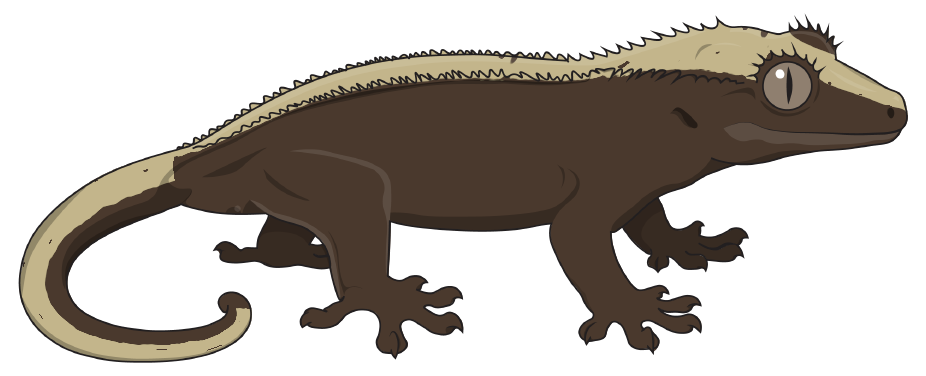
What it looks like
Black Base is the dark body colour behind the pattern. It runs from brown through to nearly black, and the same gecko can look lighter or darker depending on whether it's fired up or down.
On that dark background a gecko can carry white pattern, orange pattern or both. Black also sits underneath other colours: on some yellow geckos, black shows through around the knees, toes and gaps in the tiger markings.
Breeders write Black and Red in two ways. In the one-slot notation, Black and Red share a single gene, so a gecko is B/B, B/r or r/r: a B/r gecko looks dark and carries Red, and an r/r gecko is a Red Base. Foundation Genetics instead treats Red as its own recessive trait, separate from Black, so each gets a pair: the same dark carrier is written B/B +/r, and a Red Base B/B r/r. Ordinary carrier pairings give the same odds either way, one Red in four from two carriers, so the difference is about the model rather than the babies you can expect.
The series
Same animal, same seed. Only this gene changes. Open any one in the builder.
With another gene
The same gecko before and after.
Hypo on Black Base makes Lavender
Hypo lightens the dark base into lavender and purple tones.
Yellow on Black Base reads as Olive
Yellow sits on top of the black base, giving olive to greenish-yellow.
Named combinations
Morphs that need this gene and at least one other.
Charcoaltakes some work
Dark black-base Phantoms: a charcoal to dark grey gecko with little pattern. Foundation Genetics notes they can be bred to other dark Phantoms for all-Phantom babies with varying brown tones, some with white on the belly or kneecaps.
NeedsPhantomBlack Base
Halloweeneasy to breed
Vivid orange pattern on a dark base: orange and black, like the holiday. Foundation Genetics keeps white out of a true Halloween.
NeedsBlack BaseOrange Pattern
Lavendertakes some work
Lavender, purple or blue-shifted colour in place of the usual dark base, from Hypo lightening Black Base. The pastel tones often deepen with age. Other routes can look lavender too, so there is no universal recipe.
NeedsBlack BaseHypo
Oliveeasy to breed
Olive to greenish-yellow: Yellow Base over Black Base gives olive and khaki-green tones, strongest when fired down and brighter yellow when fired up. Other combinations can look olive too, so there is no universal recipe.
NeedsYellow BaseBlack Base
With other genes
Hypomake Lavender
Hypo on Black Base lightens the dark base to lavender, purple or blue-shifted tones.
Related looks
Combinations, two-copy forms and named variations built on this one.
OG NoirLineage
OG Noir is a Pangea Reptile line name for dark Phantom geckos. It's a family tree rather than a recipe: a dark Phantom carries the name only if its pedigree traces back to the line. How it relates to the older OG Black name is still to be confirmed by breeders.
Notes
How it is inheritedBreeders describe Black Base as fixed dominant, so one copy is enough for a dark gecko. Black is a dark base colour, and the part that matters when you pair it is Red. Breeders usually treat Red as recessive, so two dark geckos can produce red babies if both carry it. A gecko can carry Red without showing it, so a dark gecko's colour won't tell you what it carries.
Where breeders differHow Black and Red relate hasn't been settled. One view puts them on the same gene; Foundation Genetics describes Black as probably separate from the other base colours, with Red as its own recessive factor. The usual carrier-to-carrier pairings give the same odds under either view, so those results alone don't settle it.
Where it came fromNo single founder is on record for this name. It is shared hobby vocabulary. Foundation Genetics traces it to the early hobby, when wild-type geckos were loosely called buckskin and ranged from very dark to light tan or dirty yellow, and describes black, yellow, phantom and hypo forms separating out through selective breeding.
In Gecktopia
Black and Red share one slot in the game. Every gecko carries two of them between them: B/B, B/r or r/r. B/B and B/r are both drawn dark, so a B/r gecko looks black and can still pass on Red. Yellow is modelled separately, on its own gene. This is the model the game chose; the reference above records the disagreement.
- Passed on in the game as dominant.
- Shares one slot in the game with Red Base.
Sources
Foundation Genetics, current online edition
Foundation Genetics contributors, date not established
Only the relevant sections were reviewed.
Keeper’s Choice crested gecko descriptions
Pangea Reptile, date not established
Anthony and Jessica Vasquez, Tom Favazza and breeder collaborators, date not established
Foundation Genetics Part 2.1: Base Color Morphs
Foundation Genetics contributors, date not established
Foundation Genetics contributors, date not established
Pangea Reptile, date not established
Entry 1 of 33. Every gecko on this page was drawn from its own genes just now, by the renderer that draws them in the game.