Entry 14Pattern
Dalmatian
Dark spots over the body.
DAL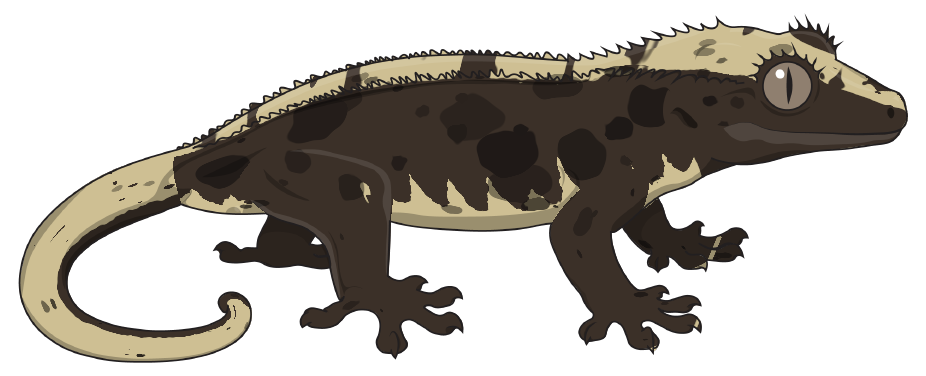
What it looks like
Dalmatian geckos carry distinct spots scattered over their other colours and pattern, anywhere from a few spots to over a hundred. Black spots are the most common; red spots are prized, orange spots also appear, and green to yellow spots are the rarest.
Spots range from a grain of salt to about the size of a pea, and exceptionally large ones are called ink spots. Spotting can change: FoxReptiles notes hatchlings don't always show many spots and more can appear with age depending on the line, and Foundation Genetics notes spots can seem to vanish when a gecko fires down. Spot count, size and colour are separate things to look at, and a few scattered spots are often just called dal spots rather than a Dalmatian.
The series
Same animal, same seed. Only this gene changes. Open any one in the builder.
Named combinations
Morphs that need this gene and at least one other.
Bullseye
A dark Dalmatian spot with red inside it: black outside, red in the middle. Gecktopia describes it in its own entry.
NeedsDalmatianBullseye
Confettitakes some work
Dalmatian spotting in more than one colour, red spots among the black. Confetti is also Altitude Exotics' line name, credited to Brian Butler.
NeedsDalmatianRed Spot
Ink Spottakes some work
Large, solid, sharp-edged spots, sometimes overlapping into clusters that read as shapes. Usually black, but any spot colour counts. Big spots alone do not show that a gecko has two Dalmatian copies. Gecktopia describes it in its own entry.
NeedsDalmatianInk Spot
Oil Spot
Faded spots the gecko's own colour reads through, hollow in the middle when large. They can sit alongside Dalmatian spotting. Gecktopia describes them in their own entry.
NeedsDalmatianOil Spot
Red Spot
Dalmatian spots carrying red instead of black, in the same sizes and places. Gecktopia describes it in its own entry.
NeedsDalmatianRed Spot
Super Dalmatian
The two-copy (homozygous) form of Dalmatian, recognised by breeding: paired with a non-Dalmatian, it gives all Dalmatian babies (AC Reptiles). Some guides also use the name for any very heavily spotted gecko, but a spot count does not show how many copies a gecko has.
NeedsDalmatian
Related looks
Combinations, two-copy forms and named variations built on this one.
Orange SpotAppearance variation
Orange Spot is used both for orange marks along the sides and for orange-coloured Dalmatian spots, and the two don't necessarily share a cause. An orange mark first needs telling apart from ordinary orange pattern.
Notes
How it is inheritedAC Reptiles, working its own lines for about 20 years, describes Dalmatian as incomplete dominant, and credits Philippe de Vosjoli with first describing it that way. One copy gives fewer, smaller spots; two copies, the Super Dalmatian, give more and bigger ones. A Super Dalmatian is the homozygous (two-copy) form, and it is recognised by breeding rather than by counting spots: paired with a non-Dalmatian, a Super Dalmatian gives all Dalmatian babies, while a one-copy Dalmatian paired the same way gives about half spotted babies (AC Reptiles, Dalmatian). Foundation Genetics instead describes spotting as dominant with little visible difference between one and two copies. Either way, a spot count or big spots alone can't tell you how many copies a gecko has.
Where breeders differThe name Super Dalmatian is used in two ways: AC Reptiles uses it for the two-copy form, while some guides, such as FoxReptiles’, use it for any very heavily spotted gecko. Only breeding shows the two-copy form. Occasional reports of unspotted pairs producing spotted babies are also debated; AC Reptiles suspects missed spots or a female who mated earlier, while Foundation Genetics says those cases need more study.
Where it came fromNo single founder is on record for this name. It is shared hobby vocabulary. AC Reptiles calls it one of the first morph names in the hobby and recalls it already being popular with breeders in the early 2000s, and Foundation Genetics notes that several of the original wild-imported geckos came covered in spots.
In Gecktopia
Dalmatian is incomplete dominant in the game, following AC Reptiles. One copy is named Dalmatian and draws spots; two copies are named Super Dalmatian and draw them larger and overlapping. How many spots a gecko has is a separate inherited amount, so a Dalmatian or a Super Dalmatian can be lightly or heavily spotted. Ink Spot is a kind of spot of its own, like Bullseye and Red Spot, and a gecko is named Ink Spot only when it carries it. A Dalmatian that shows both red and black spots, as a hatchling and as an adult, is named Confetti. A pairing preview gives the odds of Dalmatian and Super Dalmatian, and lists Confetti and Ink Spot as possibilities.
- Passed on in the game as incomplete dominant.
Sources
Anthony Caponetto / AC Reptiles, date not established
Keeper’s Choice crested gecko descriptions
Pangea Reptile, date not established
Crested Gecko Morph / Trait Guide
Michelle / FoxReptiles, with contributed photographs, 11 July 2021
Anthony and Jessica Vasquez, Tom Favazza and breeder collaborators, date not established
Confetti project animal listing
Altitude Exotics, date not established
Reviewed through search results; the page itself could not be read in full.
Entry 14 of 33. Every gecko on this page was drawn from its own genes just now, by the renderer that draws them in the game.