GecktopiaJoin the Hatch List

DEVELOPMENT NOTES FROM GECKTOPIA

Building a world one gecko at a time.

A quiet record of meaningful milestones behind Gecktopia’s crested gecko genetics, renderer, and living bloodlines. Updates arrive when there is something worth showing.

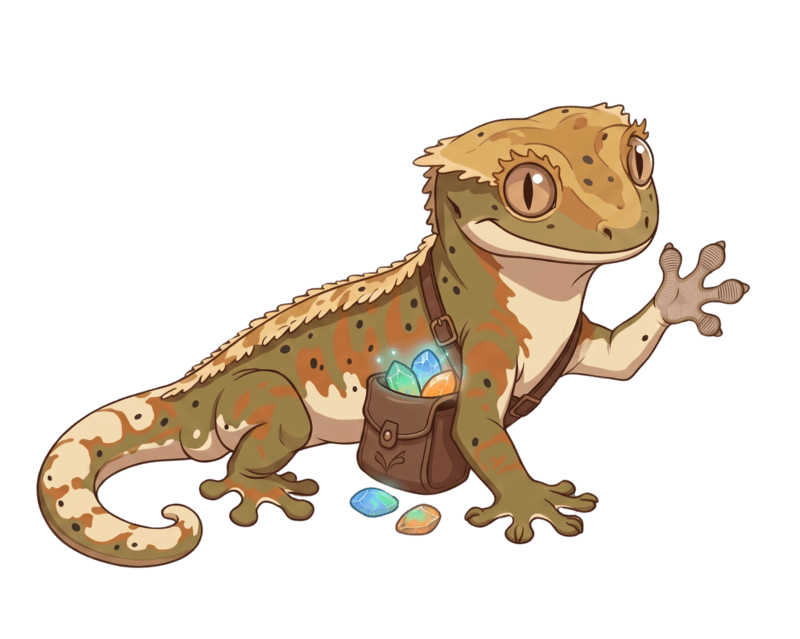
Gecko Garry, a softly illustrated crested gecko

ENTRY 003

A Renderer That Reads Genetics

The renderer has been rebuilt. It no longer takes a list of appearance settings: it takes a gecko’s genes and works out what the animal should look like, using the same crested gecko genetics database that powers ReptiDex.

That changes what the site can be. There is now a morph builder, where you choose genes and watch the gecko redraw, and a morph library with a page for every morph the renderer can draw. Eighteen are covered so far: the three base colours, Hypo, Phantom, Axanthic and Fire, then Harlequin, Flame, Pinstripe, Quadstripe, Dalmatian, Empty Back, Tiger, Lilly White and Patternless, along with the pattern colours that make a Tri-Color or a Halloween.

The art it draws on was redrawn too. The gecko is built from real illustrated pieces, with guides for the pin rows, the belly line, the chin, and now the fringe and kneecaps, so a marking lands where it belongs on the animal rather than where a rule of thumb puts it.

Most of this month went into getting the genetics right rather than the pixels. Pinstripe turns out to be plain dominant, and the broken look people call a partial pinstripe is Tiger cutting across the pin rows. Quadstripe inherits separately, so the game gives it its own gene. Dalmatian decides whether a gecko has spots while a separate value decides how many, because a Super Dalmatian is a lot of spots rather than a different genotype. Phantom and Empty Back turn out to work the same way, as overlays over the pattern, one light and one dark.

Where the research is unsettled, the game makes a choice and says so. A new guide on the site sets out where the genetics come from and exactly where we simplify or invent, so nobody has to guess which parts are real.

Every gecko on the site is drawn from genes by this renderer. Nothing is concept art, and nothing is a finished sprite pulled from a folder. Change one gene and the animal changes; change the seed and the same genes give you a different individual, which is the point: a morph is a range, not a picture.

Next is pairing: choosing two animals and seeing what could hatch, using the same genetics. After that, the rest of the database, morph by morph.

Expected hatch date: early 2028.
ENTRY 002

Patterns With a Memory

Gecktopia’s renderer can now dynamically generate unique pattern realizations for individual crested geckos. The animal on the homepage is no longer chosen from a library of finished sprites. It is assembled from a complete appearance recipe that can be reproduced whenever the same inputs return.

That repeatability matters. A gecko’s markings are part of its persistent identity, so an animal should still look like itself when it appears in a habitat, pedigree, pairing screen, or future generation record. Changing the recipe creates visible variation. Restoring it brings the same gecko back.

The current draft renderer can generate dorsal, upper-lateral, and lower-lateral pattern coverage. It also supports independent left and right pinstripe continuity, ordinary pattern colors, and Dalmatian spots. These layers combine with the gecko’s base color, shading, highlights, and line art to create a growing range of individuals.

Each marking remains constrained to authored regions of the animal. Dorsal pattern stays on the dorsal surface, lateral markings stay on their corresponding sides, pinstripes follow their guides, and Dalmatian spots remain within the available body area.

You can now meet one of these geckos directly on the Gecktopia homepage. The focused controls show the central idea quickly, while the Gecko Lab opens the deeper draft inputs currently supported by the renderer.

This is still a calibration-stage renderer rather than the final range of crested gecko variation. More pattern families, structure, firing, and inherited visual relationships remain ahead. The important foundation is now visible: each gecko can have markings that belong to that individual and persist with it.

Expected hatch date: early 2028.

ENTRY 001

No More Patternless Geckos

Gecktopia began as an idea only a few weeks ago, but development is already in full swing.

A great deal of these first weeks has happened beneath the surface. The major design decisions that will shape Gecktopia have been locked in, and the game’s foundational systems have been carefully planned and documented. This early groundwork may not produce the most exciting screenshots, but it gives us a strong foundation for the much more visible work ahead.

Gecktopia is being built as a crested gecko breeding game centered on genetics, discovery, lineage, and the animals you raise across generations. That means every gecko needs to feel like its own persistent animal, not simply a collection of interchangeable colors placed on the same body. Establishing how those identities will be created, inherited, and preserved has been one of the most important parts of development so far.

We have also reached our first small visual milestone: the earliest version of the gecko generator has passed its basic tests.

Until now, our test geckos have been rather plain little creatures. They were useful for confirming that the underlying pieces worked, but they did not yet demonstrate the variety Gecktopia is meant to produce. Our latest tests successfully combined individually prepared pattern assets into distinct geckos, which means we are officially no longer working with an entirely patternless population.

This is still a very early step. The generator has a long way to go before it can represent the depth of color, pattern, structure, and inheritance planned for the finished game. Still, seeing those first unique markings appear was an encouraging sign that the foundation is beginning to come alive.

There is not much of Gecktopia ready to show just yet, but there is now quite a lot taking shape behind the scenes.

Expected hatch date: early 2028.

FOLLOW THE BLOODLINE

Join the hatch list.

Occasional development milestones and renderer updates. No noise, no weekly promises.

Expected hatch date in early 2028